From Image Generator to Body Scanner: Midjourney’s Stunning Medical Hardware Pivot
Midjourney has unveiled a full-body ultrasound scanner that images the human body in 60 seconds, with plans to house the devices inside its own wellness spas starting in 2027. The unexpected medical hardware pivot positions the AI image company at the frontier of consumer health diagnostics, built in partnership with ultrasound chip maker Butterfly Network.
When you think of Midjourney, you think of text prompts blooming into surreal, painterly images. You do not think of ultrasound rings, spa facilities, or full-body health diagnostics. That is precisely what makes the company’s latest announcement so disorienting — and so worth paying attention to.
According to The Rundown AI, Midjourney has revealed a full-body scanner that lowers users through an ultrasound ring and produces a comprehensive body map in just 60 seconds. The device is called the Midjourney Scanner, and it represents one of the most unexpected pivots in recent AI history. A company that built its reputation turning creative prompts into visual art is now trying to image the inside of the human body.

What the Midjourney Scanner Actually Does
The hardware works by lowering a person through water and a ring of ultrasonic sensors. The underwater medium is not incidental — it helps ultrasound waves travel more efficiently through tissue, enabling a more detailed image. Midjourney founder David Holz has claimed the scanner rivals an MRI in the level of detail it captures, all within a single minute of scan time.
To build this device, Midjourney partnered with Butterfly Network, a company that specialises in ultrasound chip manufacturing. Butterfly Network has been a significant player in democratising portable ultrasound technology, so the collaboration gives the Midjourney Scanner a degree of technical credibility that the announcement might otherwise lack.
For context, a traditional MRI scan in India can take anywhere from 30 minutes to over an hour depending on the area being imaged, and costs can range from roughly ₹5,000 to ₹25,000 or more depending on the facility and body part. The promise of a 60-second full-body scan at a consumer-facing spa location is, if it holds up under clinical scrutiny, a genuinely significant development.
The Spa Wrapper: Genius or Gimmick?
Here is where the announcement gets either very smart or very strange, depending on your perspective. Midjourney is not planning to deploy its scanner through hospitals, clinics, or diagnostic chains. Instead, the first Midjourney Spa is slated to open in 2027 in San Francisco’s Union Square, pairing roughly 10 scanners with saunas, cold plunges, and hot tubs.
The wellness spa framing is a deliberate choice. Rather than positioning the scanner as a medical device that requires a doctor’s referral and insurance approval, Midjourney is wrapping it in the language of self-care and preventive health. You go for a spa day. You also happen to get a full-body map of your internal health.
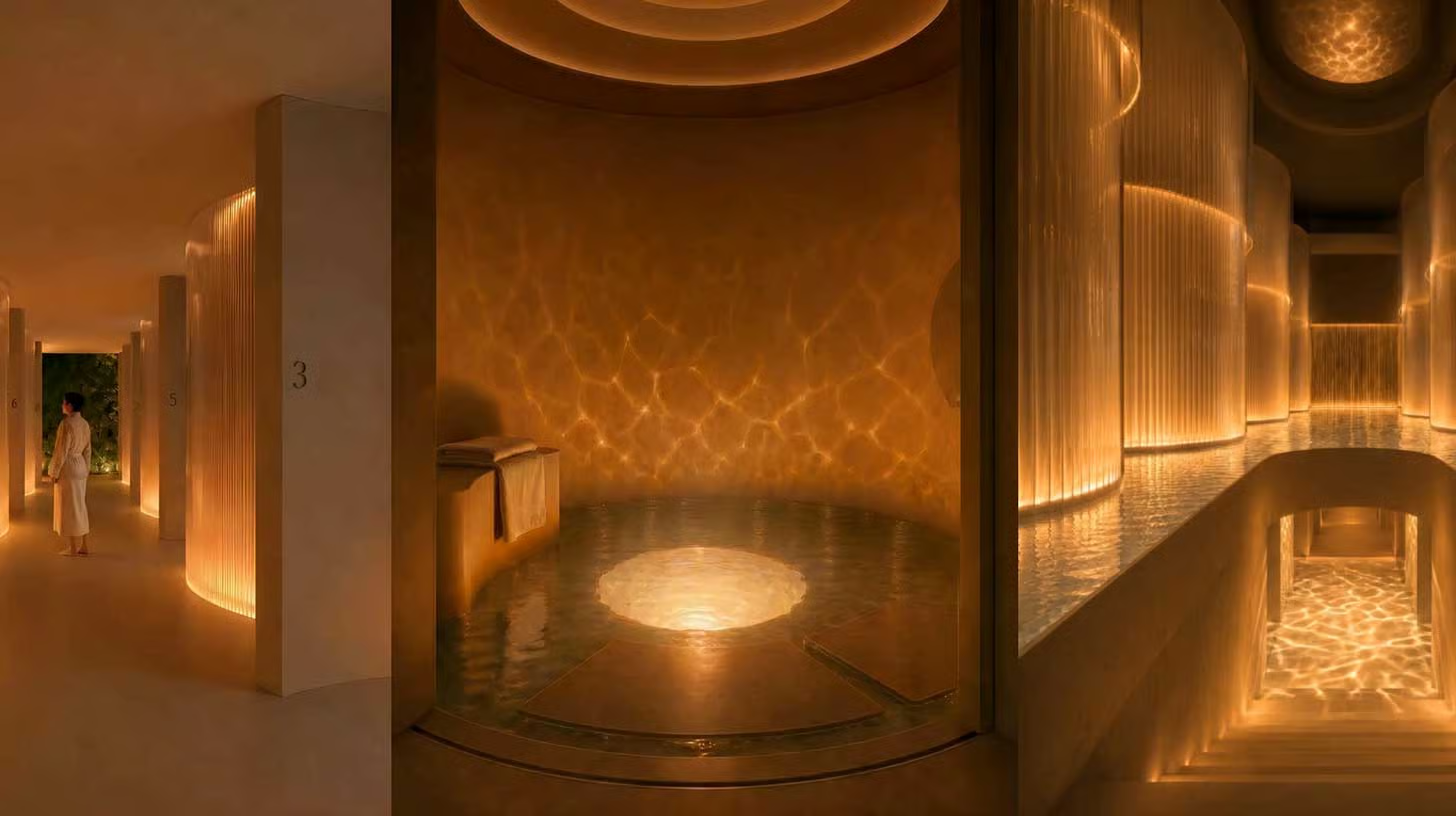
This strategy has a clear logic behind it. Regulatory pathways for medical devices are long, expensive, and uncertain. Consumer wellness products face a lower bar — though they also come with the caveat that health claims must be carefully managed. By framing the scanner as part of a wellness experience rather than a diagnostic medical tool, Midjourney may be finding a faster route to market while the technology matures and accumulates the data needed for deeper clinical validation.
The Rundown AI notes that there is still plenty to prove out — a fair and important caveat. Ultrasound imaging quality varies enormously based on operator skill, patient body composition, and the specific transducer technology used. Claiming MRI-level detail is an extraordinary statement that will require extraordinary evidence. Until independent clinical validation exists, the comparison should be treated as an aspiration rather than an established fact.
Why This Move Makes Strategic Sense for Midjourney
Midjourney has always been something of an outlier in the AI landscape. It is a relatively small team that has generated enormous cultural impact through its image generation models. But image generation, however impressive, is a crowded market. OpenAI’s image tools, Google’s Imagen, Adobe Firefly, and dozens of other competitors are all competing for the same creative use cases.
Expanding into medical hardware is a way of planting a flag in territory where the competition is far less mature. The intersection of consumer wellness, AI-powered diagnostics, and accessible health data is genuinely underserved. If Midjourney can execute — and that is a substantial if — it could become a first-mover in a category that has enormous long-term value.
The timing also aligns with a broader cultural moment. The Rundown AI highlights that Rowan Cheung, the newsletter’s founder, recently spoke with Demis Hassabis of Google DeepMind, who expressed growing confidence that AI could help address all diseases within a decade or two. Whether or not that timeline is accurate, the idea that collecting detailed, longitudinal health data today will be enormously valuable as medical AI matures is gaining traction among people who think seriously about the future of healthcare.
A full-body scan that produces a detailed internal map — repeated annually or even more frequently — would be exactly the kind of rich data source that future medical AI systems could use to detect anomalies, track changes over time, and personalise health recommendations. Midjourney, by building the scanning infrastructure and the spa network, would sit at the origin point of that data pipeline.
What Indian Audiences Should Watch
For audiences in India, this development is worth tracking on multiple levels. India has a significant and persistent gap in preventive healthcare access. Diagnostic imaging is concentrated in urban centres, and even where it exists, cost and wait times remain barriers for many people. A technology that can produce detailed body scans quickly and in a consumer-friendly environment — if it can be scaled and priced accessibly — speaks directly to a gap that the Indian healthcare system has long struggled with.
The spa rollout starting in San Francisco in 2027 is clearly a premium, Western market entry point. But the underlying technology, if validated, could eventually find application in higher-volume, lower-cost formats that are more appropriate for markets like India. Telemedicine platforms, diagnostic chains, and health-tech startups here would do well to follow the clinical validation story closely.
Midjourney’s Mysterious Product Roadmap
Perhaps the most intriguing element of this announcement is what it implies about Midjourney’s broader ambitions. The Rundown AI points out that Midjourney’s homepage currently lists several “TBA” products alongside the scanner reveal. A company that has gone from image generation to medical hardware in a single announcement clearly has an unconventional vision for what it wants to become.
David Holz has always positioned Midjourney as a company interested in expanding human imagination and perception, not simply in building image generation tools. The body scanner, strange as it seems, is arguably consistent with that framing — it is a device that lets you see something you could not see before, in this case, the interior of your own body rendered in detail and speed previously unavailable outside a hospital.
The Bottom Line
Midjourney’s pivot to medical hardware is either a visionary leap or an overreach, and it is far too early to know which. What is certain is that the announcement is unlike anything else happening in AI right now. A creative AI company building ultrasound body scanners and planning to house them in wellness spas is the kind of development that forces you to reconsider what AI companies are actually competing to become.
The technology still needs clinical validation. The regulatory path for any health-related claims will be complex. The 2027 launch is still over a year away. But as The Rundown AI notes, the kind of future that once seemed far-fetched is starting to look a great deal closer — and Midjourney, improbably, has placed itself at the front of that story.