When India’s largest tech firm partners with AI safety leaders: TCS-Anthropic alliance signals regulated enterprise AI’s next phase
TCS partners with Anthropic to deploy Claude AI across regulated industries, positioning safety-focused AI for enterprise adoption. The partnership signals how Indian technology leaders are shaping the next phase of enterprise AI implementation.
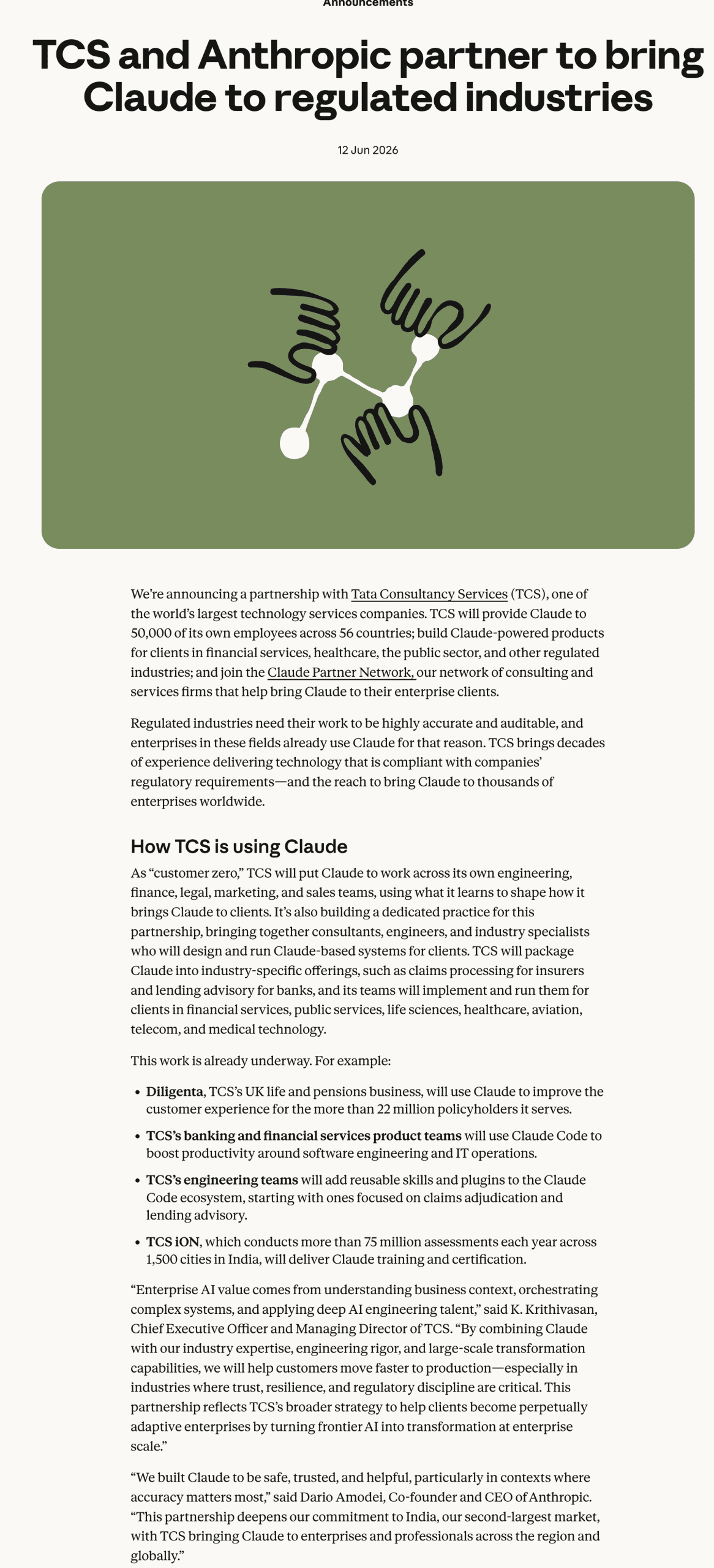
The world’s enterprise AI landscape shifted this week when Tata Consultancy Services announced its partnership with Anthropic to bring Claude AI to regulated industries. The announcement, revealed in a recent industry publication, positions India’s largest IT services company as both early adopter and distribution channel for one of the most safety-focused AI systems in the market.
For professionals watching the enterprise AI space, this partnership represents more than just another technology deal. It signals how safety-first AI approaches are finally finding their footing in the high-stakes world of regulated industries — and how Indian technology leaders are positioning themselves at the center of this transformation.
The Scale of Ambition
TCS isn’t approaching this partnership tentatively. The company plans to deploy Claude across its 50,000+ employees spanning 56 countries, making it one of the largest enterprise AI rollouts by headcount in recent memory. This scope alone suggests confidence in Claude’s ability to handle diverse, real-world enterprise workflows across engineering, finance, legal, marketing, and sales teams.
The partnership structure reveals TCS’s dual strategy: become “customer zero” to prove Claude’s enterprise readiness while simultaneously building a practice to serve external clients. This approach mirrors how successful technology adoptions typically unfold in large Indian IT services companies — prove internally, then scale externally.
What makes this particularly significant is the focus on regulated industries. Financial services, healthcare, and public sector organizations have been notably cautious about AI adoption, primarily due to compliance requirements and accuracy concerns. TCS’s commitment to building industry-specific offerings — from claims processing for insurers to lending advisory for banks — suggests these barriers are becoming surmountable.
Safety Meets Scale in Regulated Markets
Anthropic’s positioning as a safety-focused AI company creates an interesting dynamic here. While competitors have rushed to market with capabilities-first approaches, Anthropic has consistently emphasized constitutional AI and safety measures. For regulated industries where a single AI error can trigger compliance violations or customer harm, this approach suddenly becomes a competitive advantage rather than a constraint.
The partnership announcement specifically highlights accuracy as crucial “where accuracy matters most.” This isn’t marketing speak — it’s a recognition that regulated industries operate under different risk profiles than consumer applications. When TCS’s Diligenta business uses Claude to improve customer experience for 4+ million UK life and pension policyholders, the stakes are materially different than a chatbot helping someone plan dinner.
This safety-first approach may explain why Anthropic chose to partner with a services-heavy company like TCS rather than pursuing direct enterprise sales. TCS brings not just distribution reach but also the implementation expertise to deploy AI systems within complex regulatory frameworks. Their experience navigating compliance requirements across dozens of countries becomes a strategic asset for Anthropic’s enterprise ambitions.
The India Context: Beyond Implementation
While the partnership announcement focuses on global deployment, the India angle deserves particular attention. Dario Amodei’s comment about India being Anthropic’s “second-largest market” suggests significant existing adoption, even before this partnership scales up distribution.
TCS iON’s involvement adds another layer of significance. The platform already reaches 1,500+ cities in India with 75+ million annual assessments. Adding Claude training and certification to this network could create India’s largest AI education initiative, potentially shaping how an entire generation of professionals approaches AI tools.
For Indian professionals, this partnership represents more than just access to another AI tool. It signals that safety-focused AI approaches are gaining traction in enterprise environments, potentially creating new career paths around AI implementation in regulated industries. The emphasis on building “reusable skills and plugins” for specific use cases like claims adjudication suggests opportunities for specialized AI implementation expertise.
What This Reveals About Enterprise AI’s Evolution
The TCS-Anthropic partnership illuminates several trends reshaping enterprise AI adoption. First, the age of generic AI tools is giving way to industry-specific implementations. TCS isn’t just providing Claude access — they’re building specialized offerings for different regulated sectors.
Second, safety and compliance are becoming differentiators rather than constraints. While earlier enterprise AI adoption focused on raw capabilities, regulated industries are now sophisticated enough to evaluate AI systems based on reliability, explainability, and safety measures.
Third, the partnership model suggests that successful enterprise AI deployment requires more than just technology. It requires implementation expertise, industry knowledge, and ongoing support — exactly what large IT services companies provide.
The Broader Implications for Regulated Industries
This partnership could accelerate AI adoption across regulated industries that have remained cautious. When a company with TCS’s reputation for compliance and risk management endorses an AI system for regulated use cases, it provides cover for other organizations considering similar deployments.
The specific examples already underway — from improving customer experience for millions of policyholders to boosting software engineering productivity in banking — demonstrate concrete value rather than speculative benefits. This evidence-based approach to AI adoption may prove more persuasive than capability demonstrations for risk-averse regulated industries.
For financial services firms, healthcare organizations, and public sector entities watching from the sidelines, TCS’s implementation experience will provide valuable data points about what works, what doesn’t, and how to navigate regulatory requirements while deploying enterprise AI.
Looking Forward: The New Enterprise AI Playbook
The TCS-Anthropic partnership suggests a maturing approach to enterprise AI that prioritizes safety, compliance, and industry-specific implementation over raw technological capabilities. This evolution may favor AI companies that have invested heavily in safety research and implementation partners with deep regulatory expertise.
For Indian technology professionals, this partnership creates immediate opportunities around AI implementation in regulated industries while signaling longer-term shifts in how enterprise technology adoption unfolds. The emphasis on building specialized skills and industry-specific plugins suggests that AI implementation expertise will become increasingly valuable.
As this partnership scales across TCS’s global operations, it will provide one of the first large-scale case studies of safety-focused AI deployment in regulated industries. The results will likely influence how other technology services companies approach enterprise AI partnerships and how regulated industries evaluate AI adoption strategies.
The stakes extend beyond any single partnership. If TCS successfully demonstrates that safety-focused AI can deliver business value in regulated industries, it could accelerate broader enterprise AI adoption while establishing new standards for how AI systems are evaluated and deployed in high-stakes environments.