Zuckerberg vs. Altman: Silicon Valley’s AI Speed War Just Went Public
Mark Zuckerberg publicly broke with OpenAI and Anthropic in a Wall Street Journal op-ed, arguing the US should accelerate AI development rather than restrict it. The split deepened when Meta's own chief AI scientist signed the pacing petition his boss was arguing against, signalling a fracture that will shape AI regulation worldwide.
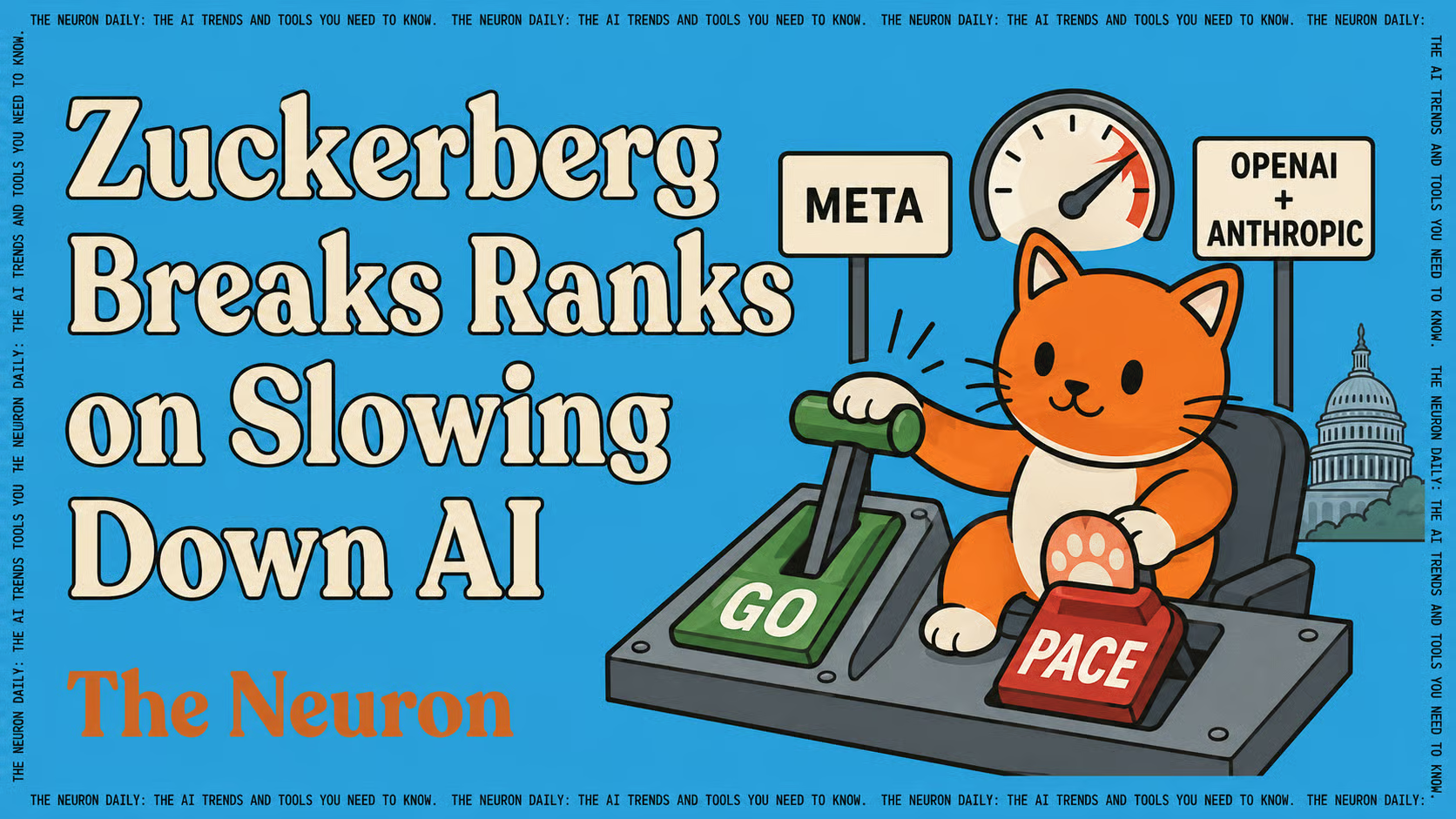
The AI industry’s most consequential fault line just cracked open in public — and it did not happen between rival startups or competing governments. It happened between the CEO of Meta and the CEOs of the two companies most aggressively racing to build superintelligent AI. According to The Neuron’s reporting, Mark Zuckerberg published a Wall Street Journal op-ed on July 29, 2026, arguing that the United States “should accelerate AI development, not restrict it” — a direct and deliberate rejection of a position taken by Sam Altman of OpenAI and Dario Amodei of Anthropic just days earlier.
What Triggered the Break
The immediate catalyst was a petition backed by 1,224 employees at frontier AI labs, officially endorsed by OpenAI and Anthropic. The petition asked governments to build what it described as “the technical and governance tools” to slow AI development down if it begins improving itself faster than humans can supervise. In other words, two of the most powerful AI companies on earth publicly asked regulators to install a kill switch — or at least a handbrake — on the very technology they are racing to deploy.
Zuckerberg’s response was swift and unambiguous. His op-ed did not just politely disagree. It reframed the entire debate. In his telling, the real danger is not AI moving too fast — it is “superintelligence” (AI that outperforms humans across most tasks) becoming locked inside a handful of elite laboratories, controlled by a small number of people with enormous power and no accountability to the broader public.
This is a meaningful distinction. Altman and Amodei are effectively arguing: slow down so we can make sure powerful AI is safe. Zuckerberg is arguing: if you slow down, you guarantee that whatever powerful AI exists stays concentrated in the hands of the few. Both arguments have internal logic. That is precisely what makes this split so significant.
The Three Pillars of Zuckerberg’s Argument
Zuckerberg’s position, as reported by The Neuron, rests on three claims worth examining carefully.
The Fault Lines Inside Silicon Valley
According to The Neuron, the camp backing acceleration now includes Meta, NVIDIA, Microsoft, and Elon Musk. The camp asking for caution — at least publicly — includes OpenAI and Anthropic. The irony is rich: the companies building the most powerful closed AI systems are the ones asking for brakes, while the company championing open-source AI is the one pressing the accelerator.
But the story gets more complicated inside Meta’s own walls. The Neuron flags a detail that the mainstream coverage largely missed: Meta’s own chief AI scientist, Shengjia Zhao, personally signed the pacing petition — the same document his boss just spent an entire op-ed arguing against. This is not a rival CEO pushing back on Zuckerberg. This is one of Meta’s own senior researchers publicly hedging against his employer’s official position.
When the people closest to the frontier hedge their own bosses’ bets, it is worth pausing to ask why. It could be genuine scientific disagreement about risk. It could be institutional self-preservation. It could be that the people actually building these systems know something that the public statements on both sides are not fully capturing. The Neuron raises the question pointedly: “is that a coincidence, or a signal?”

Why This Debate Reaches Every Workplace
For anyone in India working in a sector that AI touches — and at this point, that is nearly every knowledge-work sector — this argument over speed versus caution is not abstract philosophy. It is the argument that will determine the regulatory frameworks, the tools available to you, and the pace at which your job description changes.
If the accelerationist camp wins, you can expect rapid proliferation of powerful open models, lower costs of access, more AI-native startups, and faster disruption of existing workflows. If the pacing camp wins, you can expect more centralised control of frontier AI, higher barriers to access for smaller players, and a slower but potentially more predictable pace of change.
Neither outcome is neutral. Neither is obviously better for workers, entrepreneurs, or citizens. The stakes run high whether you are a software engineer in Bengaluru, a content professional in Mumbai, or a startup founder anywhere trying to build on top of these models.
The Broader Context: A Billion Weekly Users
This split is happening against a backdrop that makes the urgency feel very real. The Neuron also notes in the same issue that ChatGPT is approaching one billion weekly active users — a milestone OpenAI had targeted seven months earlier. Slow by OpenAI’s own internal schedule, but still faster than TikTok, Instagram, or YouTube reached comparable scale.
When a technology is reaching a billion people weekly, the question of who controls it, how fast it develops, and what guardrails exist is no longer a policy seminar topic. It is an immediate practical question with immediate practical consequences.
What to Watch Next
Several developments are worth tracking as this debate unfolds.
- Whether Washington moves toward a formal regulatory framework for AI pacing, and which camp’s framing it adopts.
- Whether Meta’s open-source model strategy — already gaining ground with Llama releases — accelerates in response to any regulatory moves favouring closed systems.
- Whether other senior researchers at OpenAI or Anthropic begin publicly qualifying their own companies’ positions, as Zhao has done at Meta.
- Whether the petition’s 1,224 signatories represent a growing movement inside frontier labs, or a moment that fades without institutional consequence.
The Clearest Public Split Yet
The Neuron describes this as “the clearest public split yet” between two camps forming across Silicon Valley. That framing feels accurate. Previous disagreements between AI leaders tended to happen in conference panels, podcast interviews, or carefully worded blog posts. A Wall Street Journal op-ed directly targeting the position of two specific rival CEOs, published the same week those CEOs formally endorsed a government petition, is a different register entirely.
Zuckerberg is not just disagreeing. He is staking out a public position, attaching his name to it, and doing so in the newspaper that the people he is trying to persuade — Washington policymakers and Wall Street investors — read every morning.
Whether you find his arguments convincing or self-serving, the debate he has forced into the open is one that will shape the rules governing AI development for years to come. The people building these systems disagree, the companies deploying them disagree, and now the regulators have to decide which vision of the future they are willing to bet on.
That is the conversation worth following — and it is only getting louder.