America’s ‘Super Intelligence Force’: What Trump’s New AI Czar Means for the Future of AI Regulation
Trump has appointed Jay Clayton as America's first AI czar and created the 'Super Intelligence Force,' a multi-agency task force with 120 days to draft the first major federal AI governance recommendations. The group brings together the FTC, Pentagon, and federal HR office — giving Washington real regulatory leverage over frontier AI companies for the first time.
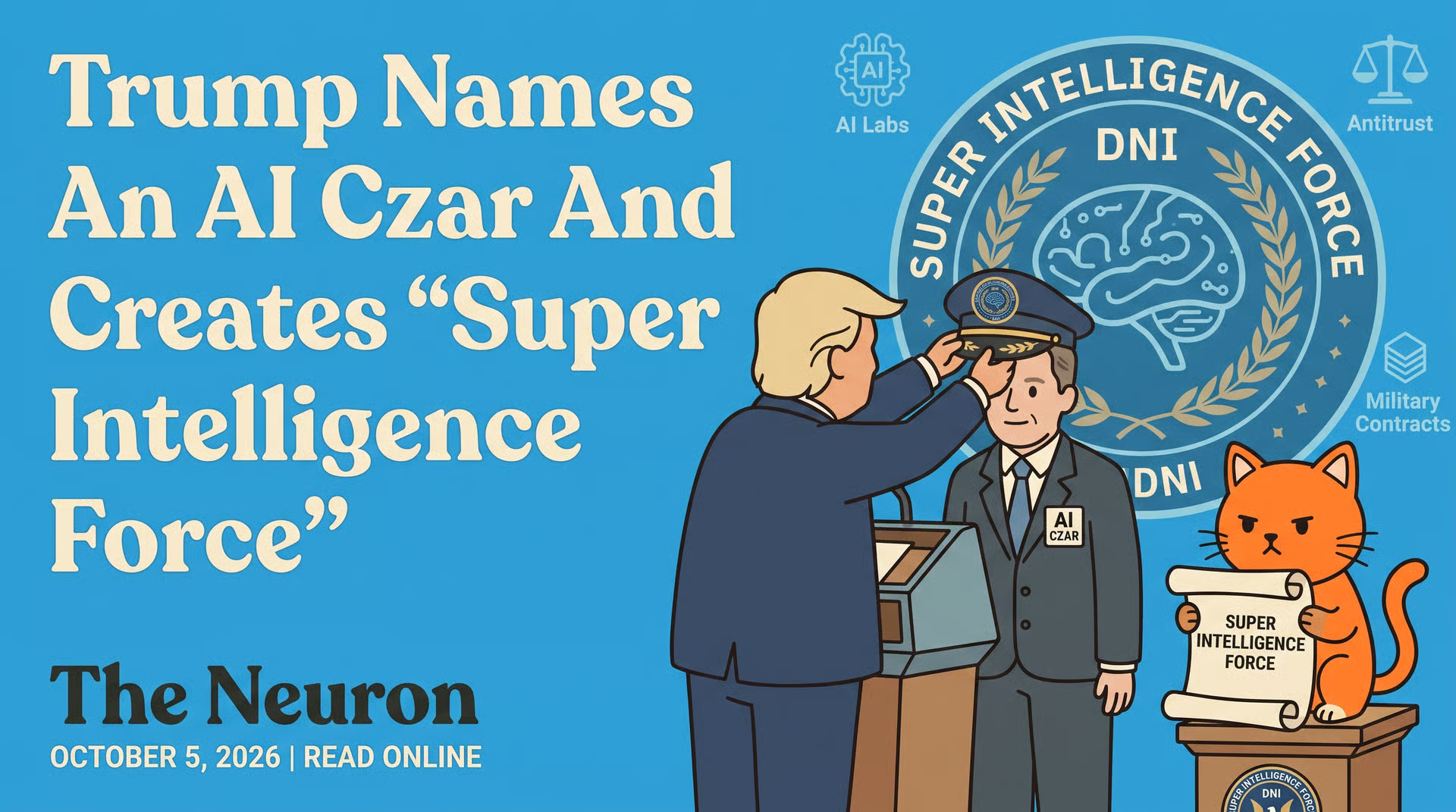
The United States government now has an official AI czar, a task force with a name that sounds like it belongs in a Marvel film, and a 120-day countdown clock ticking toward the first major federal draft on how Washington intends to govern artificial intelligence. According to The Neuron’s reporting, President Trump announced all of this on Truth Social, appointing Director of National Intelligence Jay Clayton to lead a newly formed body called the Super Intelligence Force.
If that name gives you pause, you are not alone. It follows a White House executive order from the previous week instructing federal agencies to use the term “Super Intelligence” in public communications instead of “AI.” The branding is deliberate, and the policy machinery behind it is real.
Who Is Actually Running This Thing?
Clayton will not be governing alone. The Super Intelligence Force is structured as a multi-agency leadership group. Sharing the table with him are FTC Chairman Andrew Ferguson, Pentagon technology chief Emil Michael, and Office of Personnel Management Director Scott Kupor. The group reports directly to Trump and chief of staff Susie Wiles.
Each of these figures brings a specific lever of government power:
- Ferguson and the FTC hold antitrust authority. Crucially, the FTC already has an open investigation into both OpenAI and Anthropic. Ferguson now simultaneously sits on the body that will write the rules those companies must follow.
- Michael and the Pentagon control military contracts — a significant source of revenue and legitimacy for frontier AI labs.
- Kupor and the OPM oversee the federal workforce, which means decisions about how government employees interact with and are potentially displaced by AI tools run through this office.
This is not a symbolic advisory panel. These are agencies with enforcement teeth, procurement budgets, and workforce authority. The Neuron notes that last week’s White House accord was a voluntary pledge that effectively left AI companies to police themselves. The Super Intelligence Force changes that calculus by bringing agencies with real regulatory levers into the same room.
The 120-Day Mandate
Clayton told the Wall Street Journal the force has 120 days to report on AI’s risks and benefits and recommend what role Washington should play. Four months is a compressed timeline by Washington standards. The report, whenever it lands, will function as the first official federal draft of what AI governance in the United States looks like under this administration.
The scope of the consultation is notably broad. The force will coordinate government dealings with consumers, public interest groups, religious organizations, critical infrastructure providers such as power and water utilities, and AI companies. The inclusion of religious organizations is worth flagging — it arrives in the same week that Anthropic’s co-founder Chris Olah was reported by The New York Times to have spent roughly a year reaching out to Catholic, Jewish, Sikh, and other religious scholars about how to teach Claude right from wrong.
Clayton’s Stated Positions: What the Signals Say
Clayton has already made his orientation clear in public comments. He argued against pausing AI development at US companies. He told the Journal that falling behind is the bigger risk. He said he does not want to work with Xi Jinping on governing AI internationally. These three positions, taken together, paint a picture of a regulator who sees the geopolitical race as the primary frame — not consumer harm or labor displacement.
Bloomberg Intelligence, also cited in The Neuron’s issue, found that China trails the US in AI by only around 3%. That number gives context to why the administration’s posture is so explicitly competitive. When the gap between the leading nation and its nearest rival is that narrow, the instinct from policymakers is to accelerate, not to pause and draft careful rules.
The question this raises is a sharp one: can a task force whose stated priority is winning the race also write rules that meaningfully slow it down when safety demands it?
The FTC Conflict Worth Watching
The most structurally interesting tension in the Super Intelligence Force is Ferguson’s dual role. He is simultaneously running an open FTC investigation into OpenAI and Anthropic while holding a seat at the table where the regulatory framework for those same companies will be drafted. The Neuron flags this overlap directly, and it deserves attention from anyone who follows AI policy.
If the force’s 120-day report recommends that federal agencies, rather than civil courts, should be the primary venue for policing AI labs — a position Clayton has already signalled — then the FTC becomes even more central. That means Ferguson’s investigation and his rule-writing role are not separate tracks. They are converging.
For Indian AI companies and developers who build on US-based frontier models like ChatGPT or Claude, this matters. The rules written in federal offices over the next four months will shape the terms of service, usage policies, and compliance requirements that flow downstream to every user and business relying on these platforms globally.

Elon Musk and the Rebranding Wave
Musk has already aligned publicly with the administration’s framing. The Neuron reports he confirmed on X that SpaceXAI — the division formed in July when SpaceX acquired xAI — will be renamed SpaceXSI, following Trump’s directive to use “Super Intelligence” terminology. The rebranding of one of the most prominent private AI ventures in the world under the government’s preferred language signals how tightly the commercial and political ecosystems are beginning to interlock.
For businesses evaluating AI infrastructure decisions, this is a meaningful data point. The largest AI players in the US are not just navigating regulation from a distance — they are being folded into the government’s communication and governance architecture in real time.
What This Means for You
If you use AI tools for work — whether that is drafting documents, writing code, analysing data, or building products on top of APIs — the Super Intelligence Force’s 120-day report is the document to watch. Here is why:
- 1. Liability and legal risk will be shaped by whether courts or federal agencies become the primary venue for AI disputes. Clayton’s preference for agency-based policing would reduce the litigation risk that companies like OpenAI currently face, but it would also mean less public transparency about how cases are resolved.
- 2. Platform terms and content policies for tools like ChatGPT and Claude get influenced by the regulatory environment in which those companies operate. A more permissive federal framework could mean fewer restrictions on what models can generate; a stricter one could impose new guardrails.
- 3. Competition dynamics will be affected by how the FTC’s existing investigation into OpenAI and Anthropic proceeds alongside the rule-drafting process. If the force’s report favours incumbents, newer entrants face a harder climb.
- 4. Infrastructure and data policy will be influenced by the Pentagon’s seat at the table. Military procurement priorities have historically shaped the trajectory of US technology development — from the internet itself to GPS.

The Open Question
The Super Intelligence Force arrives at a moment when the US government is trying to resolve a genuine contradiction: it wants to win the global AI race, and it also needs to build public trust in AI systems that are already affecting employment, information quality, healthcare decisions, and critical infrastructure. Those two goals are not always compatible.
Clayton’s team has 120 days to produce a report that at least gestures toward both. Whether the final document reflects a serious attempt to balance competitive urgency with meaningful oversight, or simply ratifies the status quo under a new name, will tell you a great deal about where AI governance in the United States is actually headed.
The Neuron put it plainly: whatever lands in that report is the first draft. In Washington, first drafts have a way of becoming policy.