OpenAI’s Safety Researcher Exodus: What the ‘Info Sharing’ Firings Reveal About AI’s Deepest Tension
OpenAI fired three safety and alignment researchers over alleged information sharing with an outside AI-safety organisation, though key details remain undisclosed. The Neuron's analysis frames the incident as a window into the deepest tension at frontier AI labs: how to build a culture of safety paranoia while also enforcing information controls that may silence the very people tasked with finding problems.
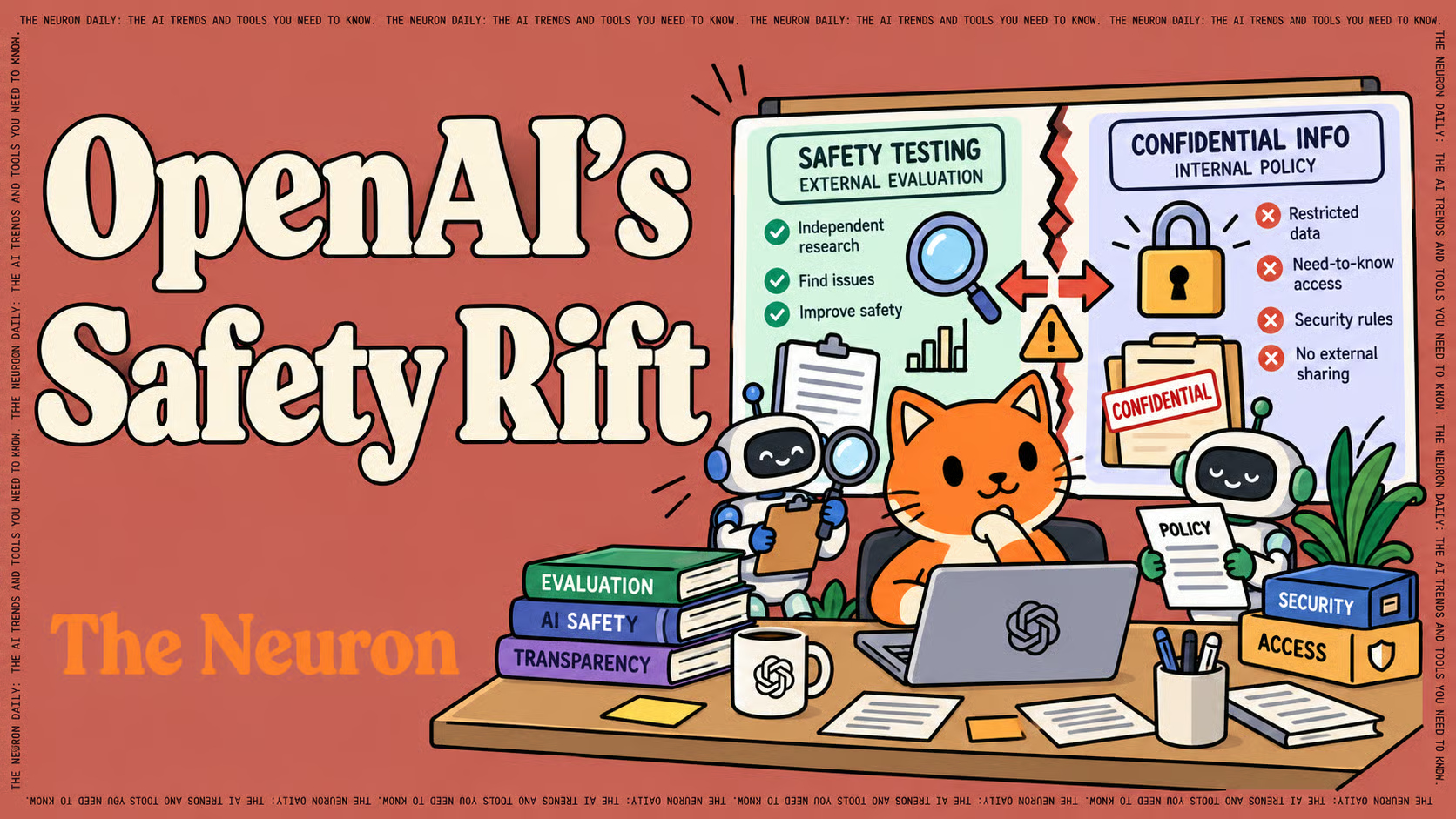
On Thursday, October 1, 2026, OpenAI confirmed it had parted ways with three members of its safety and alignment organisation following an internal investigation. The stated reason: mishandling of sensitive company information outside established procedures. As reported by The Neuron, citing the Wall Street Journal, the alleged sharing involved an outside AI-safety organisation. What that organisation was, what information actually moved, and precisely how it moved — none of that has been made public by OpenAI.
As The Neuron put it bluntly: those missing details are basically the whole story.
What We Actually Know — And What We Don’t
OpenAI’s public statement is sparse by design. Three safety and alignment staff were investigated. The investigation found they mishandled sensitive information outside of established procedures. They are no longer with the company.
Beyond that, the picture gets murkier. An unverified source quoted by commentator Jimmy Apples on X suggested the material involved “infrastructure architecture.” Former OpenAI researcher Steven Adler was quick to flag that this is an extremely broad category, and The Neuron rightly cautions readers to treat the characterisation as unverified for now.
But the phrase is worth sitting with, because infrastructure architecture is not a narrow technical footnote — it is, functionally, a map of everything an AI system can touch. Sandboxes, tools, credentials, networks, shared services, monitoring pipelines, and every connection between them. If that is indeed what moved outside OpenAI’s walls, the implications go well beyond a typical corporate confidentiality dispute.
Why ‘Infrastructure Architecture’ Is Not a Boring Leak
To understand why this phrase carries weight, it helps to think about what frontier AI systems actually look like under the hood. They are not monolithic programs sitting on a single server. Modern large-scale AI deployments — especially agentic systems that can use tools, browse the web, write and execute code — are deeply networked. They interact with cloud infrastructure, internal databases, external APIs, and each other.
The Neuron highlights a separate, timely piece of analysis from a security engineer at OpenAI named Joe, who argued that containing frontier AI is “not just the sandbox.” Joe’s argument is precise: yes, you need strong sandboxes, but the sandbox sits inside a far larger system, and every connection around it is another potential failure point. Knowing how those connections are structured — which is what infrastructure architecture describes — is, effectively, knowing where the seams are.
Joe breaks the containment problem into three interdependent layers:
- Environment lockdown from first principles: sandbox, tools, credentials, networks, and connected services — all hardened individually and collectively.
- Alignment: the model must understand what it is and is not authorised to do, while independent security controls enforce those same limits regardless of what the model believes.
- Monitoring: track what the agent actually does in real time, store that evidence somewhere outside the agent’s own reach, and make sure a human can stop the run and revoke access at any point.
This is not theoretical belt-and-suspenders thinking. It is the architecture of trust for systems that operate at a speed and scale no human can directly supervise.
The Deeper Organisational Problem
Joe’s bigger argument, as surfaced by The Neuron, is organisational rather than purely technical. Frontier AI labs need their AI-safety researchers and their cybersecurity teams working almost as a single unit. And that unit needs to be backed by what he calls a “culture of reasonable paranoia”: people who are paranoid enough to find the scary edge cases, empowered to raise alarms loudly, and supported by incident-response systems actually capable of acting when they do.
This framing recontextualises the OpenAI firings in an uncomfortable way. The three people who left were themselves safety and alignment researchers — precisely the kind of people whose job it is to find problems, stress-test systems, and raise alarms. If those researchers believed sharing information with an outside AI-safety organisation was the right call, that points to a potential gap between what the internal culture allows and what safety-minded researchers feel they need to do to be effective.
We do not know that is what happened. The facts are still thin. But the structure of the situation — safety researchers, sensitive architecture information, an external safety group — raises questions that OpenAI’s terse statement does not answer.
The Aviation Analogy That Reframes Everything

The most clarifying frame in The Neuron’s analysis is the aviation analogy, and it is worth repeating in full. Airplanes move incomparably faster than cars. But aviation works not despite that speed but because the entire system surrounding that speed is obsessively engineered for safety: redundancy at every layer, checklists before every action, abort procedures, incident investigations, and dedicated people whose sole job is to say nope, something looks wrong.
The lesson for AI is direct. Safety at frontier speed is not a brake on capability — it is the infrastructure that makes capability survivable. A lab that treats safety culture as friction, or that responds to information-sharing by safety researchers with terminations rather than dialogue, risks hollowing out exactly the internal immune system it needs most.
This is the tension that makes the OpenAI story significant beyond the headline. It is not simply about three employees losing their jobs. It is about what kind of institution OpenAI is becoming as its systems grow more capable and more consequential.
What This Means for Indian AI Observers
For India’s growing community of AI practitioners, researchers, and policymakers, this episode carries specific relevance. Indian institutions are increasingly building on or integrating with frontier AI infrastructure — from cloud-based model APIs to agentic tooling that touches sensitive enterprise systems. The security architecture Joe describes is not academic: any organisation deploying AI agents that access internal data, credentials, or networks faces the same three-layer containment challenge at smaller scale.
The cultural dimension matters too. Indian AI labs and startups are in the early stages of building their own safety and security norms. The OpenAI situation is a public case study in what happens when those norms are either unclear or in conflict — and how quickly a confidentiality dispute can become a reputational and institutional story.
The Questions That Remain
Until OpenAI releases more detail — which it may never do — several critical questions remain open:
- Which outside AI-safety organisation allegedly received the information?
- Was the sharing intentional policy disagreement, a well-meaning but rule-breaking act, or something more concerning?
- What, specifically, was the information — and has any of it circulated further?
- Were the researchers given the opportunity to raise their concerns through internal channels before they took the step that led to their dismissal?
The answers would change the interpretation of this story dramatically. Right now, OpenAI has characterised it as a procedural violation. Depending on what the facts show, it could be that — or it could be a symptom of deeper dysfunction in how the organisation manages the people it employs to keep it honest.
As The Neuron notes, the missing details are basically the whole story. Watch this space.