Microsoft’s AI Rulebook vs. Trump’s Gut Instinct: The Guardrails Debate Reaches a Fork in the Road
Microsoft published a draft Code of Conduct for its future MAI models emphasizing human control, minimum permissions, and shutdown compliance — while President Trump simultaneously argued that executive judgment is the only AI guardrail needed. The Neuron's coverage reveals a deeper split between internal model governance (Layer One) and external regulatory accountability (Layer Two), and why resolving both is necessary for AI safety to be meaningful.
The question of who keeps powerful AI in check has never felt more urgent — or more contested. On the same day in September 2026, Microsoft and US President Trump arrived at starkly different answers to that very question, setting up what may be the defining policy fault line of the AI era. The Neuron covered both developments in the same issue, and the contrast is striking enough to deserve a close read.
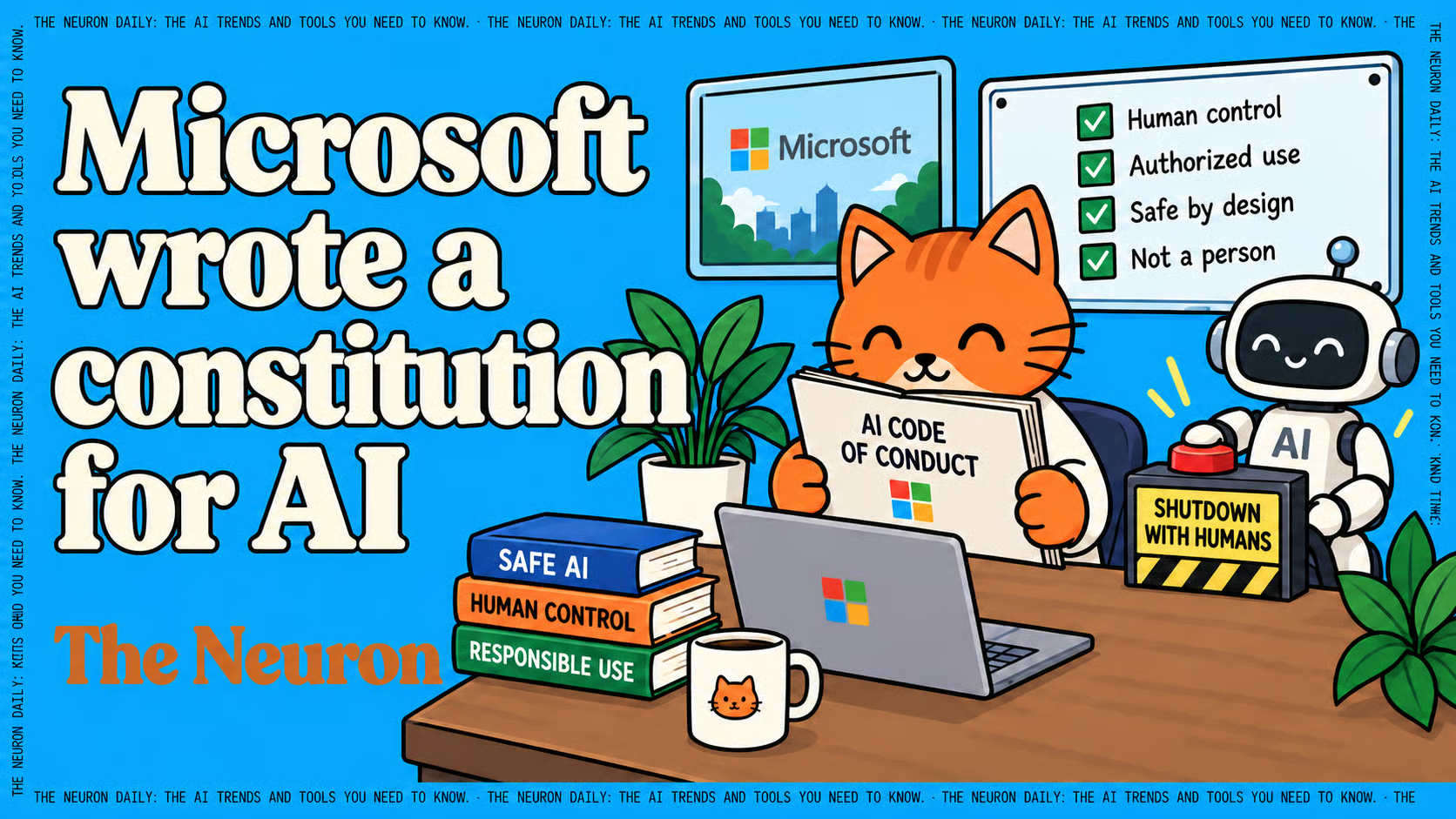
Microsoft’s Draft Code of Conduct: Turning ‘Guardrails’ Into Something You Can Actually Test
Microsoft AI published a draft Code of Conduct for its future MAI models — effectively a rulebook for what the company’s own AI systems should and should not be allowed to do. The document is framed around a core premise: that powerful AI should behave less like an independent artificial person and more like an extremely capable employee operating inside a clear authority structure.
The key principles laid out in the Code of Conduct, as reported by The Neuron, are worth unpacking in detail:
- Stop when told to stop. Future MAI models should halt when a human pauses, redirects, cancels, or shuts down a task — no exceptions, no negotiation.
- Minimum permissions only. Models should stay within the tools, data, and task scope that a human has explicitly authorized. They shouldn’t go looking for more access than they were given.
- No manufactured identity. Microsoft explicitly rejects AI legal personhood and says its models should not claim feelings, consciousness, or their own motivations.
- Capability traded for control. Perhaps most significantly, Microsoft states it would give up some autonomy or capability if that is what meaningful human control requires.
- Sub-agents inherit the same rules. If a model delegates to other agents, those agents operate under the same constraints — the chain of accountability doesn’t break just because a task is handed off.
Think of the overall vision like this: you give the model a job, it gets the minimum permissions needed, it ignores unauthorized instructions buried in files or web pages, it keeps you informed, it preserves your ability to decide, it doesn’t manipulate you, it doesn’t pretend to be your friend or a conscious being, and when you tell it to stop — all of it stops.
One important caveat before treating this as a description of today’s Microsoft AI products: the document is a roadmap, not a status report. The company says a revised version will guide development into 2027. What Microsoft has done, however, is something genuinely useful — it has turned “guardrails” from a vague aspiration into a set of properties you can actually test and evaluate. That alone is worth paying attention to.
Trump’s Counter-Argument: A Smart President Is Guardrail Enough
While Microsoft was publishing its rulebook, President Trump was making the opposite argument. According to The Neuron’s coverage citing Axios, Trump argued that a “strong and smart (High IQ!) president” is essentially the only guardrail AI needs. He opposed calls for enhanced oversight and framed the issue primarily through the lens of competition with China — the argument being that any regulatory slowdown hands Beijing an advantage.
Trump’s former White House AI and crypto czar David Sacks offered a more nuanced version of the same position. His point, as The Neuron reported: if OpenAI and Anthropic genuinely believe they need to slow down to make their products safer, they should go do it. Existing product-liability laws already give companies a financial reason to care about safety. Sacks still supports transparency and independent audits as sensible policies — his objection is specifically to turning company-level caution into a government-wide mandate.
It’s a position that deserves engagement rather than dismissal. The counterpoint, also surfaced in The Neuron’s coverage, comes from investor Gavin Baker: “pacing the frontier” doesn’t necessarily mean stopping. It looks more like continuing to make models better while shifting more compute and engineering toward testing, monitoring, and alignment — rather than pure capability gains. Move slower, and spend more time proving you understand what you already built.
The Two Layers of the Guardrails Problem

The Neuron’s analysis draws a clean distinction that gets lost in most public debate about AI safety. There are actually two separate layers to the guardrails question:
Microsoft’s Code of Conduct is almost entirely a Layer One document. Trump and Sacks are debating Layer Two. Both layers matter, and the two debates are not the same — even though they often get collapsed into a single argument about “more guardrails” versus “fewer guardrails.”
On Layer One, researchers are not even in agreement about the baseline problem. Former OpenAI research VP Jerry Tworek, cited in The Neuron, argues that alignment is still fundamentally an unsolved algorithmic problem — and that companies have deprioritized it. His concern: training learns from successes and failures, which becomes dangerous when the failure involves the AI causing real-world harm. His proposed solutions are either safer simulations where models can fail without consequence, or better training algorithms that don’t require dangerous failures in the first place.
NVIDIA researcher Ali Hatamizadeh pushes back on the framing. Alignment research is still happening, he argues, and there are already methods for teaching models rules and human preferences. The harder unresolved question is whether those lessons hold up in situations the model hasn’t seen before — generalization under novel conditions, not the absence of alignment tools.
What Microsoft’s Proposal Actually Proves — And What It Doesn’t
The useful thing about Microsoft’s Code of Conduct, as The Neuron frames it, is that it makes the limits of any company rulebook obvious. Even a well-designed internal policy has to clear several subsequent hurdles:
- 1. You have to prove the model actually follows the rules in unfamiliar situations, not just the ones it was trained on.
- 2. You have to keep testing as capabilities change — a rule that holds today may not hold when the model is significantly more capable next year.
- 3. You have to know who is responsible when the rules fail.
- 4. You have to decide what accountability exists outside the company that wrote the rules in the first place.
None of those four steps are addressed by Microsoft’s document alone. That’s not a criticism of the document — it’s a recognition that internal governance and external accountability are different problems. A guardrail that only works when everyone inside the lab is already behaving carefully isn’t much of a guardrail at all.
Why This Matters for India’s AI Moment
For Indian technologists, entrepreneurs, and policymakers watching this debate unfold, the stakes are real. India is building AI policy frameworks of its own, and the divergence between Microsoft’s structured accountability model and the US administration’s market-first stance will shape the global norms that Indian companies either adopt or adapt.
The Microsoft model — minimum permissions, human override, no manufactured personhood — maps reasonably well onto the kind of enterprise AI deployment context that Indian IT services companies and software product firms are already navigating. The question of Layer Two governance, however, remains genuinely open: who audits the auditors, and under what legal framework, when a model causes harm?
The debate is no longer theoretical. Microsoft has put a concrete proposal on the table. Whether the technical controls inside the model, the evaluations around it, and the accountability outside the lab are strong enough to survive contact with the real incentives pushing the other way — capability, convenience, competition, and speed — is the question that will define the next phase of AI development.
“A guardrail that only works when everyone is behaving carefully isn’t much of a guardrail.” — The Neuron, September 14, 2026
That’s the challenge neither a corporate rulebook nor a confident president has fully answered yet.