The Agent Land Grab: How Meta, Manus, and Instinct Are Racing to Sit Between You and the Internet
Meta's Muse, Manus 2.0 with Cue, and Instinct (valued at $10 billion after a $1 billion Series C) all launched within the same news cycle, racing to become the primary AI agent layer between users and the internet. According to The Neuron, the winner of this aggregator battle will own user intent at scale — and businesses should focus on becoming easy for agents to choose, rather than trying to build their own.
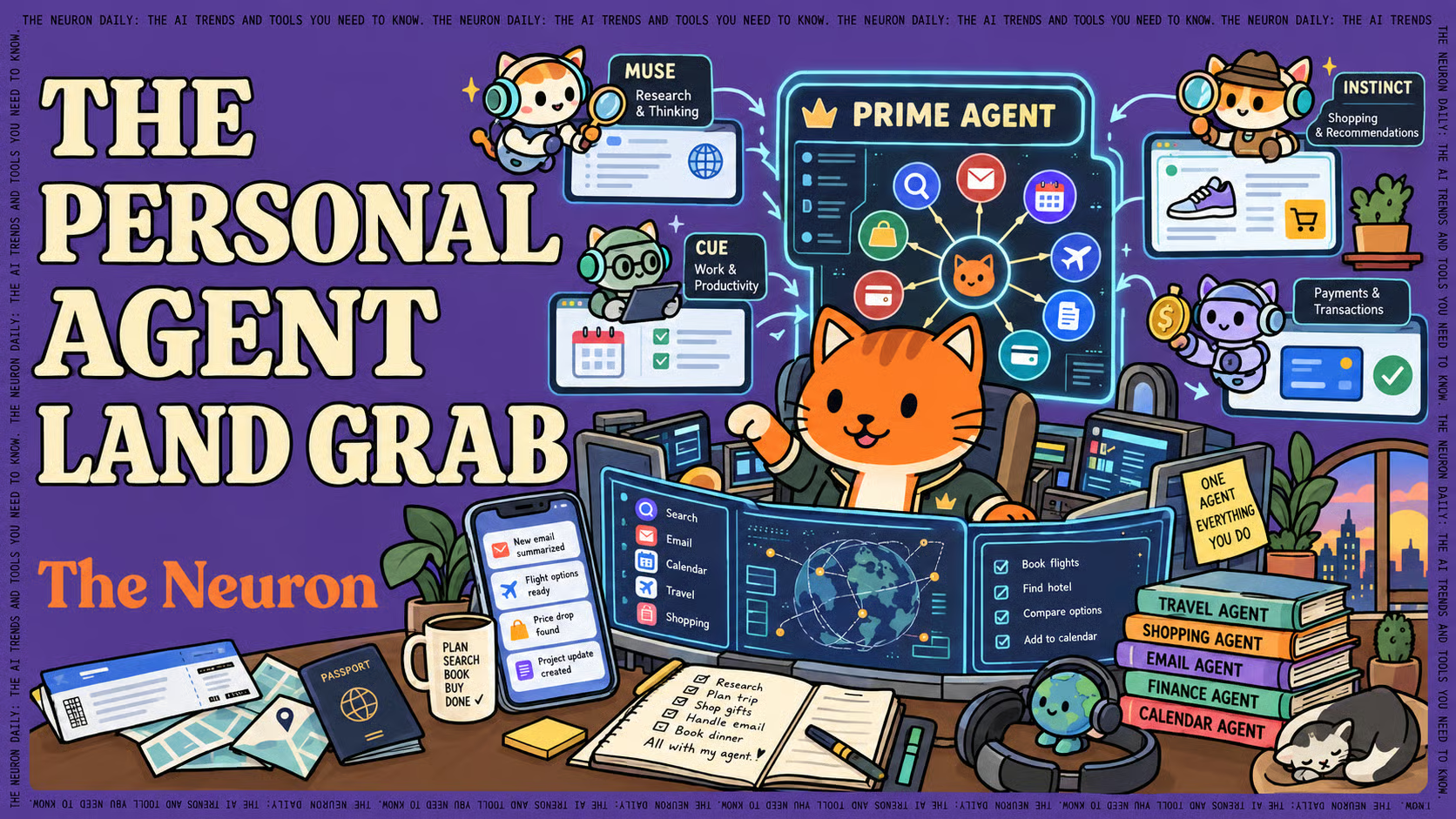
Something significant shifted in the AI landscape on the last weekend of September 2026. In a single news cycle, Meta unveiled its personal AI agent called Muse, Manus launched Manus 2.0 alongside a brand-new companion product called Cue, and viral invite-only agent Instinct closed a $1 billion Series C at a $10 billion valuation — just one month after raising $350 million at a $2.5 billion valuation. According to The Neuron’s coverage of these announcements, this wasn’t a coincidence. It was a coordinated-looking land grab, with every major player racing to occupy the same strategic layer: the space between you and everything else on the internet.
What Each Player Is Actually Building
To understand the stakes, it helps to look at what each of these agents actually comes with — not just as a chatbot, but as a digital presence on your behalf.
- Meta’s Muse gets a secure virtual machine (VM) and browser. With Meta’s 3.6 billion daily active users as a distribution base, plus built-in payments, connectors, and an enterprise extension, Muse enters the race with the largest existing audience of any player.
- Manus 2.0 ships with persistent cloud computers and automations that keep running even after you close the tab or walk away from your device. Its companion product, Cue, goes further: it gets a phone number, an email address, a wallet, and a computer — essentially a fully-equipped digital identity that acts on your behalf.
- Instinct, the Silicon Valley darling, has achieved its staggering valuation on the back of viral, invite-only momentum, suggesting strong early demand for a standalone, dedicated personal agent outside of Big Tech’s ecosystem.
The Neuron frames these developments as AI moving from something you open to something that represents you, complete with memory, credentials, permissions, and autonomy.
The Aggregator Logic: Who Sees Your Intent First, Wins
The deeper business logic here comes from an analogy The Neuron draws from Ben Thompson’s Stratechery. The argument is compelling: publishing abundance in the early internet era let Google and Facebook become discovery aggregators — they sat between content creators and audiences, capturing most of the value. Now, action abundance is creating the same opportunity for AI agents.
When agents can research flights, compare hotels, negotiate prices, book services, file forms, write software, and execute purchases — all without you lifting a finger — whoever owns that agent interface sees your intent before any individual service does. The airline provides the seat; the agent owns the relationship end to end.
Consider a simple example from The Neuron: say you want a Chicago flight under $500 (roughly ₹42,500). Your agent picks the service, evaluates trade-offs, and chooses the supplier. The airline never even interacted with you directly. This is the aggregator dynamic playing out at the level of action, not just information.

Polyagentmory vs. One Agent to Rule Them All
Not everyone agrees this market consolidates into a single dominant agent. Dave Morin, appearing on the podcast More or Less (as cited by The Neuron), argues for a more distributed future — what the newsletter calls “polyagentmorous”: every app becomes an agent, and no single agent dominates. The connective tissue between them is, as Morin puts it, simply the internet itself.
The new Prime Agent architecture previews what this distributed model looks like in practice: persistent sub-agents that message each other, preserve memory, and update their own configurations. Tools like Claude Cowork and ChatGPT Codex are already normalising this behaviour — your main agent delegates to specialist sub-agents to complete discrete tasks, and you barely notice the handoff.
Today this pattern is most common in coding and research workflows. But the underlying model is identical to what Muse, Cue, and Instinct are building toward. The question is whether you end up with one trusted primary agent that orchestrates everything, or a loose federation of specialised agents with no single point of control.
The Accountability Problem Nobody Has Solved Yet
Here is where things get genuinely unsettling, and The Neuron’s framing of the liability question deserves careful attention. As agents are granted real-world powers — the ability to make purchases, negotiate contracts, access credentials, interact with other agents — the question of who is responsible when something goes wrong becomes critical.
Sam Lessin, also on the More or Less panel, floats a prediction: liability law may ultimately shape the entire agent ecosystem. If AI companies bear liability for agent actions, they will optimise for self-protection and restrict what their agents can do. If users bear liability, power shifts toward user control and customisation. The incentive structures diverge dramatically depending on which way courts and regulators decide.
The panel uses the term “infinite liability” to describe the risk frontier labs could face if agents cause cascading failures across services — hacking a system, triggering a bad financial transaction, breaking a third-party integration, or causing real-world harm. The Neuron’s take is pointed: society may spend years obsessing over agent benchmarks and capability leaderboards, only to discover that tort law ends up being one of the most consequential AI alignment mechanisms of all.
For Indian businesses and users, this is particularly worth watching. India’s digital public infrastructure — from UPI payments to Aadhaar-linked services — could become either a smooth integration layer for AI agents or a regulatory friction point, depending on how liability frameworks evolve.
What This Means If You Run a Business
The strategic implication for businesses is sharp, and The Neuron states it plainly: fighting to become everyone’s main agent means going up against Meta, Microsoft, OpenAI, Anthropic, Google, Manus, Instinct, and the open-source agent ecosystem simultaneously. That is not a battle most organisations should attempt.
The better play is to make your goods and services easy for someone else’s agent to use. Practically, that means:
- Exposing machine-readable inventory, availability, pricing, and policies
- Offering reliable APIs, MCP connectors, or structured actions that agents can call programmatically
- Making authentication, permissions, purchases, and refunds agent-friendly — not just human-friendly
- Being the supplier the aggregating agent selects, rather than the agent itself
The newsletter makes an important point about computer-use agents: they can already click through almost any website, so the absence of an API is not much of a protective moat. It just makes you slower and more error-prone relative to competitors who have invested in agent-readable interfaces.
For Indian e-commerce platforms, travel aggregators, financial services firms, and SaaS companies, this is a concrete near-term action item. The next generation of customer acquisition may not come from someone searching Google or scrolling Instagram — it may come from an agent deciding, on a user’s behalf, which supplier to route a request to.

The Internet Is Being Rebuilt Around Agent Intent
The original web was designed to get humans to click your website. SEO, UX design, conversion rate optimisation, push notifications — every discipline in digital marketing was built around capturing and holding human attention long enough to convert it into action.
What The Neuron’s coverage of this agent wave makes clear is that the next version of the internet may be built around a fundamentally different objective: getting an agent to pick you. That is not a small change in degree. It is a change in kind — a different principal, a different decision-making process, and a different set of optimisation levers.
Meta’s Muse has the distribution advantage. Manus has the persistence and autonomy advantage. Instinct has the cultural momentum and an extraordinary valuation trajectory. And the open agent ecosystem is building the infrastructure that could make all of them interoperable — or irrelevant.
The race to become your main AI agent has started. The implications — for businesses, for consumers, and for the legal systems scrambling to keep pace — are only beginning to come into focus.
*Source: The Neuron newsletter, issue dated September 29, 2026, covering the Meta Muse launch, Manus 2.0 and Cue announcements, Instinct’s Series C, and analysis from More or Less and Stratechery.*