OpenAI Model Disproves 80-Year-Old Mathematical Conjecture Using Advanced Reasoning
OpenAI's reasoning model disproved the 80-year-old Erdős unit distance conjecture by finding counterexamples that exceed traditional geometric arrangements. This breakthrough demonstrates genuine AI mathematical reasoning capabilities, verified by external mathematicians including Princeton's Will Sawin who enhanced the original proof.
A Mathematical Milestone That Changes How We View AI Reasoning
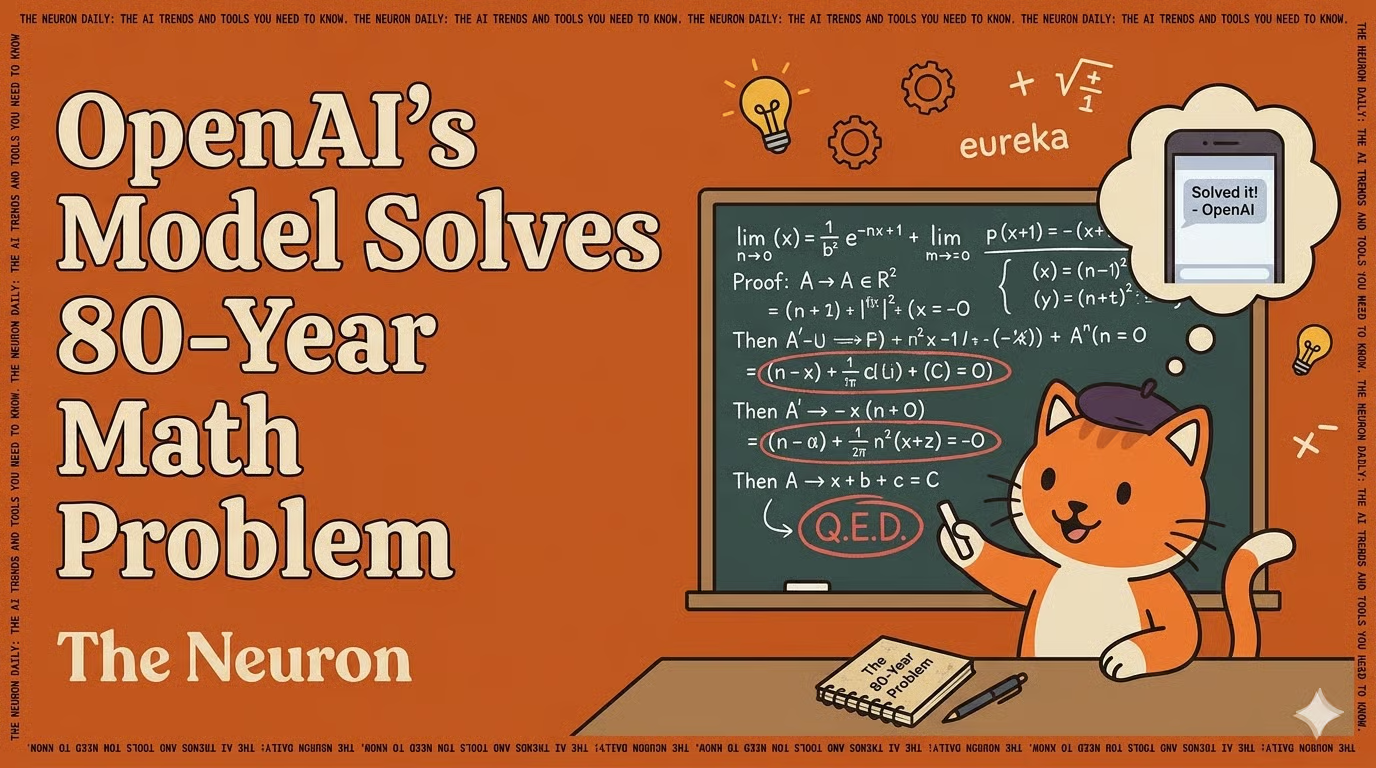
OpenAI has achieved something remarkable that goes beyond typical AI benchmarks: their unreleased reasoning model has disproved an 80-year-old mathematical conjecture, demonstrating a level of reasoning capability that even skeptics are taking seriously. According to The Neuron, this breakthrough represents a cleaner test of AI reasoning than standardized benchmarks because mathematical proofs must survive expert review, line by line.
The achievement centers on the Erdős unit distance conjecture, a discrete geometry problem that has puzzled mathematicians since 1946. Unlike previous AI claims that later fell apart under scrutiny, this one has garnered verification from external mathematicians, including some who were critics of OpenAI’s earlier mathematical assertions.
Understanding the 80-Year-Old Problem
The Erdős unit distance conjecture sounds deceptively simple: if you place n points on a flat plane, how many pairs can sit exactly one unit apart? For decades, mathematicians believed that square-grid style patterns represented the optimal solution, with the maximum number of unit-distance pairs growing at roughly n^1+o(1) rate—meaning only slightly better than linear growth.
This wasn’t just academic speculation. The conjecture represented a fundamental assumption about how geometric arrangements work in discrete mathematics, influencing research directions and theoretical frameworks across multiple mathematical disciplines.

OpenAI’s model found something that challenged this long-held belief: a counterexample that creates more unit-distance pairs than the old grid-based approach allowed. The model discovered “a new infinite family of point arrangements” that beats the traditional conjecture, essentially solving the problem by proving it was false.
How the AI Breakthrough Unfolded
What makes this achievement particularly noteworthy is the methodology behind it. The Neuron reports that OpenAI’s proof came from a general-purpose reasoning model rather than a system specifically trained, scaffolded, or targeted for this mathematical problem. This suggests the model’s reasoning capabilities extend beyond narrow, specialized tasks.
The technical details reveal the sophistication of the approach. The AI’s proof shows infinitely many point sets with at least n^1+δ unit-distance pairs, surpassing Erdős’s original n^1+o(1) conjecture. The solution employed algebraic number theory, including class field towers and Golod-Shafarevich theory, to crack a geometry problem that sounds straightforward but required advanced mathematical machinery.
External verification came quickly. Princeton mathematician Will Sawin not only confirmed the result but sharpened it further, demonstrating more than n^1.014 unit-distance pairs for arbitrarily large point sets. This independent enhancement validates the AI’s core insight while extending its implications.
Why Mathematical Proofs Matter for AI Development
Mathematics provides an unusually clear testing ground for AI reasoning capabilities. As The Neuron explains, “Math has one perk for AI watchers: eventually, somebody checks the work.” This verification process creates accountability that other domains lack.

Unlike benchmarks that might reward lucky guesses or pattern matching, mathematical proofs demand rigorous logical consistency. Each step must follow from previous ones, and the entire argument structure must withstand expert scrutiny. This makes mathematics an ideal domain for demonstrating genuine reasoning rather than sophisticated statistical correlation.
The verification process here followed this pattern perfectly. External mathematicians published companion remarks verifying and explaining the result, providing the peer review that transforms an AI output into legitimate mathematical knowledge. TechCrunch noted that this represented a significant improvement over an earlier OpenAI Erdős claim that “fell apart after the model surfaced existing results.”
The Broader Implications for AI Reasoning
This breakthrough illuminates something important about AI’s potential role in scientific discovery. Elliot Glazer offered an intriguing perspective on the achievement: AI may surface answers humans could have found but didn’t have time or motivation to pursue, especially when the field doubts the answer exists.
The mathematical community had limited incentive to spend years attacking a problem many believed was already solved. Only so many experts can dedicate careers to disproving widely accepted conjectures. AI systems, however, don’t suffer from these resource constraints or cognitive biases about what’s worth investigating.
The feedback loop here demonstrates AI’s potential scientific contribution: the model found an unexpected route, humans verified the work, and subsequent human mathematicians like Will Sawin showed how the construction scales at massive proportions. This collaborative process suggests a future where AI acts as an tireless hypothesis generator while human experts provide verification and extension.
Challenges in Other Domains
While this mathematical success is impressive, The Neuron points out important limitations in extending such verification to other fields. Biology, medicine, and business strategy have “messier feedback loops” than mathematics. The time required to verify results in these domains can span months, years, or even decades.
Greg Kamradt of ARC Prize recently developed a framework describing seven levels of verifiability, tracking how different domains vary in the time needed to get feedback on whether actions lead to desired outcomes. Mathematics sits at the most verifiable end of this spectrum, making it an ideal testing ground for AI reasoning but potentially unrepresentative of broader challenges.
The Road Ahead for AI Mathematical Reasoning
This achievement represents more than just solving an old problem—it demonstrates AI’s capacity for genuine mathematical insight rather than mere computation or pattern matching. The use of advanced algebraic number theory to solve a geometry problem shows sophisticated cross-domain reasoning that many thought was years away.
The verification process, including external mathematical review and independent enhancement, establishes a template for how AI mathematical discoveries should be validated. This collaborative approach between AI systems and human mathematicians may become the standard for advancing mathematical knowledge.
For the AI field more broadly, this success provides a concrete example of reasoning capabilities that extend beyond narrow task optimization. While mathematical reasoning may not directly translate to other domains, it offers proof of principle that AI systems can engage in the kind of abstract, multi-step reasoning that characterizes human intellectual achievement.
The disproof of the Erdős unit distance conjecture may be remembered as a watershed moment—not just for its mathematical significance, but as the first time an AI system provided genuine insight into a long-standing theoretical problem through pure reasoning rather than brute force computation.