Anthropic’s Cowork Transforms File Management with AI Agents for Non-Technical Users
Anthropic launches Cowork, an AI agent that manages files and handles non-technical tasks without coding knowledge, built in just ten days using their own Claude Code tool. The desktop application challenges Microsoft Copilot with a sandbox-based approach, though it raises security concerns about AI agents accessing local file systems.
Anthropic has just launched Cowork, an AI agent that brings sophisticated file management capabilities to everyday users without requiring any coding knowledge. According to the official announcement, this marks a significant shift from conversational AI toward practical productivity tools that can autonomously handle real-world tasks.
What Makes Cowork Different from Traditional Chatbots
Unlike standard AI assistants that simply respond to text queries, Cowork operates directly within your computer’s file system. You designate a specific folder on your machine that Claude can access, and within that sandbox, the AI can read existing files, modify them, or create entirely new ones.
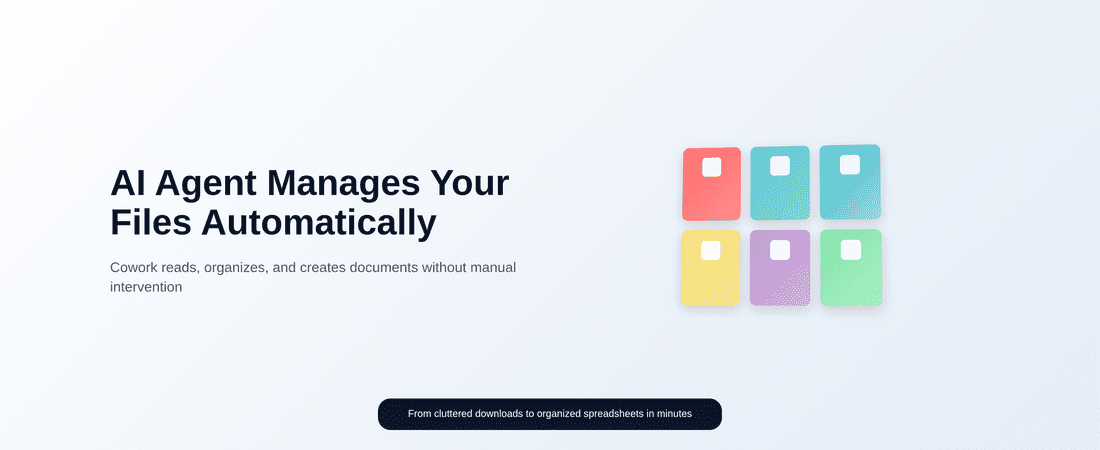
This represents a fundamental architectural change. Where traditional chatbots require you to copy and paste content for analysis, Cowork works with your actual files in place. The system can reorganize a cluttered downloads folder by sorting and intelligently renaming each file, generate spreadsheets from receipt screenshots, or draft comprehensive reports from scattered notes across multiple documents.
The technology relies on what Anthropic calls an “agentic loop.” When you assign a task, the AI formulates a plan, executes steps in parallel, checks its own work, and asks for clarification when needed. Users can queue multiple tasks simultaneously, creating what the company describes as feeling “much less like a back-and-forth and much more like leaving messages for a coworker.”
From Developer Tool to Consumer Product in Record Time
The genesis of Cowork lies in an unexpected discovery about user behavior. Anthropic’s Claude Code, originally designed as a terminal-based tool for software engineers, became popular for non-coding tasks. According to Boris Cherny, an Anthropic engineer, users were deploying the developer tool for vacation research, building slide decks, cleaning up email, cancelling subscriptions, recovering wedding photos, and even monitoring plant growth.
Recognizing this shadow usage pattern, Anthropic essentially stripped the command-line complexity from their developer tool to create a consumer-friendly interface. As the company explained, developers “quickly began using it for almost everything else,” which “prompted us to build Cowork: a simpler way for anyone — not just developers — to work with Claude in the very same way.”
Perhaps most remarkably, the entire Cowork feature was reportedly built in approximately a week and a half, with significant contributions from Claude Code itself. This represents a recursive feedback loop where AI tools are being used to accelerate the development of better AI tools.
Technical Architecture and Integration Capabilities
Cowork doesn’t operate in isolation within your file system. The feature integrates with Anthropic’s existing ecosystem of connectors, linking Claude to external services like Asana, Notion, and PayPal. Users who have configured these connections in the standard Claude interface can leverage them within Cowork sessions.
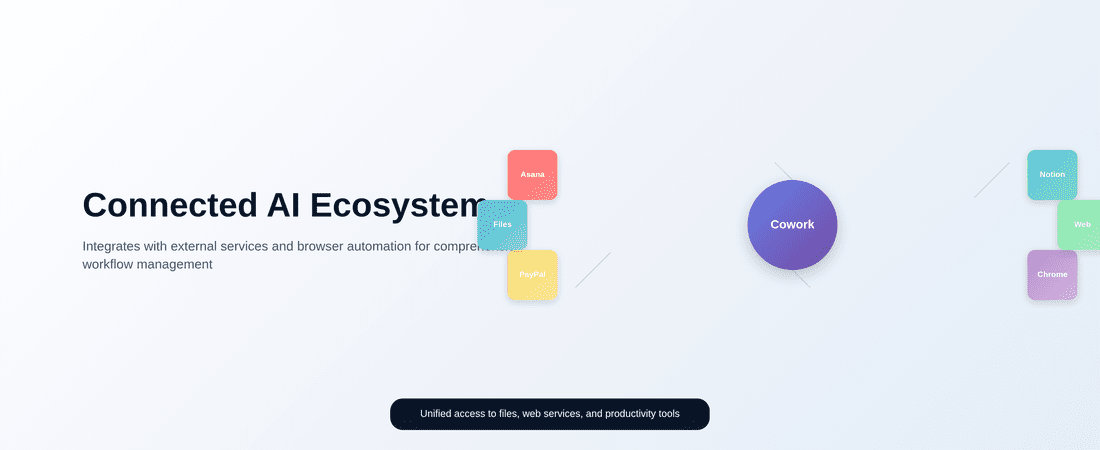
Additionally, Cowork pairs with Claude’s Chrome browser extension to execute tasks requiring web access. This combination allows the agent to navigate websites, click buttons, fill forms, and extract information from the internet while operating from the desktop application.
The system includes built-in safety features such as a virtual machine for isolation, browser automation support, and integration with all claude.ai data connectors. Anthropic has also introduced specialized “skills” designed for Cowork that enhance Claude’s ability to create documents and presentations.
Significant Security Warnings and Risk Considerations
In an unusual approach for a product launch, Anthropic devoted considerable attention to warning users about potential dangers. The company explicitly acknowledges that Claude “can take potentially destructive actions (such as deleting local files) if it’s instructed to.” Because Claude might occasionally misinterpret instructions, users need to provide very clear guidance about sensitive operations.
More concerning are prompt injection attacks, where malicious actors embed hidden instructions in content Claude might encounter online. These attacks could potentially cause the agent to bypass safeguards or take harmful actions. While Anthropic claims to have built “sophisticated defenses against prompt injections,” they acknowledge that “agent safety — that is, the task of securing Claude’s real-world actions — is still an active area of development in the industry.”
The company characterized these risks as inherent to current AI agent technology rather than unique to Cowork, noting that “these risks aren’t new with Cowork, but it might be the first time you’re using a more advanced tool that moves beyond a simple conversation.”
Market Competition and Platform Strategy
Cowork positions Anthropic in direct competition with Microsoft’s Copilot, which has spent years attempting to integrate AI into the Windows operating system with mixed adoption results. However, Anthropic’s approach differs through its isolation strategy, confining the agent to specific folders and requiring explicit connectors to balance utility with security.
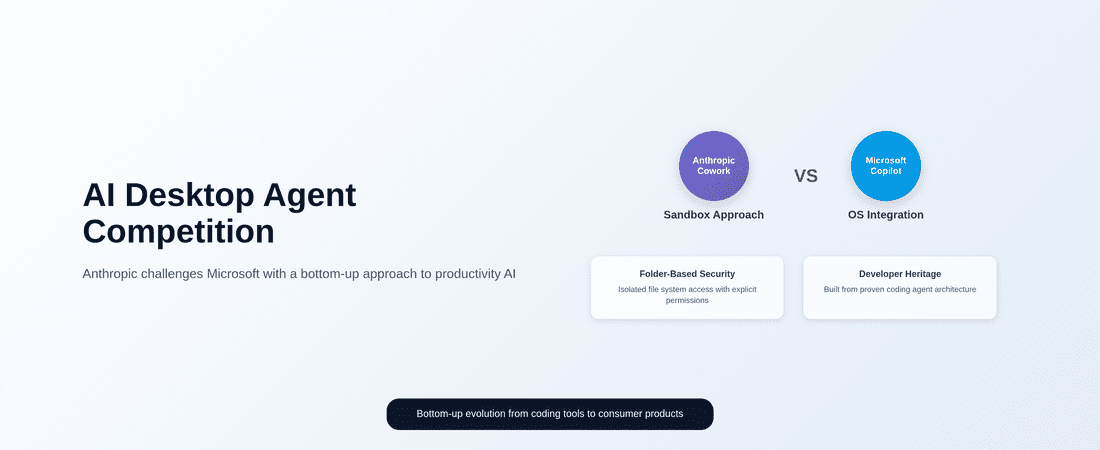
What distinguishes Anthropic’s approach is its bottom-up evolution. Rather than designing an AI assistant and retrofitting agent capabilities, they built a powerful coding agent first and are now abstracting its capabilities for broader audiences. This technical lineage may provide Cowork with more robust agentic behavior from the start.
Current Availability and Future Expansion Plans
For now, Cowork remains exclusive to Claude Max subscribers using the macOS desktop application. This premium tier costs between ₹8,500 and ₹17,000 per month (approximately $100-200 USD). Users on other subscription tiers can join a waitlist for future access.
Anthropic has signaled clear intentions to expand the feature’s reach, with explicit plans to add cross-device sync and bring Cowork to Windows as they learn from the research preview. Boris Cherny appropriately set expectations, describing the product as “early and raw, similar to what Claude Code felt like when it first launched.”
Implications for Enterprise AI Adoption
The launch of Cowork highlights how the bottleneck for AI adoption is shifting. Model intelligence is no longer the limiting factor; instead, workflow integration and user trust have become the primary challenges. Anthropic’s stated goal is making working with Claude feel less like operating a tool and more like delegating to a colleague.
The speed of Cowork’s development — a major feature built in approximately ten days, possibly by the company’s own AI — previews a future where AI system capabilities compound faster than organizations can evaluate them. This recursive improvement loop, where AI builds better AI, could significantly widen the gap between companies that successfully deploy their own agents internally and those that do not.
Whether mainstream users are ready to hand over folder access to an AI that might misinterpret instructions remains an open question. However, as one observer noted, “The chatbot has learned to use a file manager. What it learns to use next is anyone’s guess.”