The No-BS Guide to Getting Started with AI in 2026
So you’re thinking about getting started with AI. Let me guess what happened.
You’ve watched the LinkedIn posts and seen the Twitter threads. Maybe you even sat through at least one meeting where someone said “we need an AI strategy” and everyone nodded like they knew what that meant.
And yet — here you are, still not sure where to actually start.
You’re not behind, and you’re certainly not dumb. The truth is, you’re just drowning in noise.
Every week there’s a new model, a new tool, a new influencer telling you that AI will either save the world or end it. Meanwhile, you just want to know: can this thing actually help me with my job?
Short answer: yes. In fact, it’s easier than you think.
This is the guide to getting started with AI that I wish someone had sent me two years ago. No jargon. No hype. Just the practical stuff — in particular, — what to use, how to use it, and what to ignore.
Let’s go.
Getting started with AI: let’s clear the air first
Three things you need to hear:
You’re not too late. The AI wave is not a train that left the station. It’s more like the internet in 1998 — early enough that learning the basics right now puts you ahead of most professionals. Not behind them.
You don’t need to be technical. Specifically, there’s no coding required, and understanding neural networks isn’t necessary either. If you can write a clear email, you can use AI. That’s literally the skill — telling it what you want in plain language.
Nor do you need every tool. There are thousands of AI products. You need maybe three. I’ll tell you which ones.
The numbers that should wake you up
Before we get tactical, look at this:
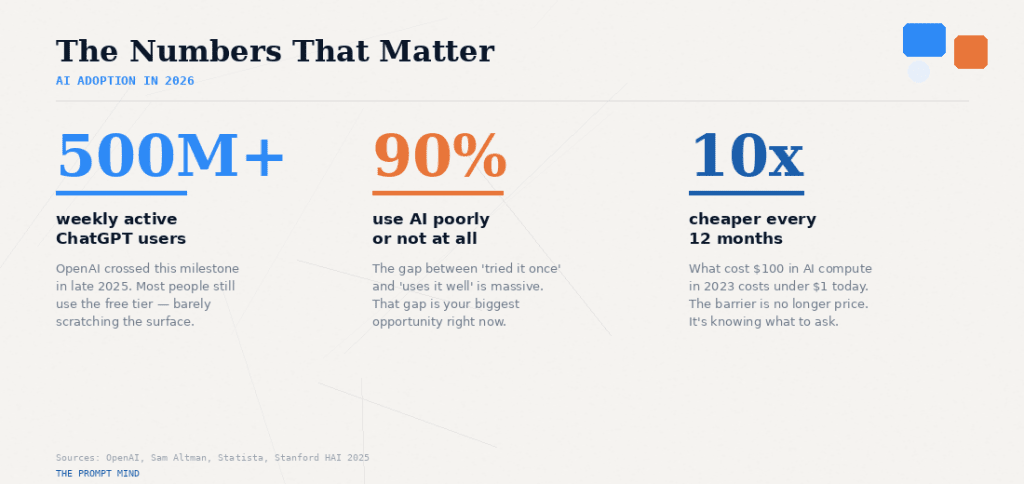
Currently, half a billion people are using ChatGPT every week. But here’s the part nobody talks about when it comes to getting started with AI — the vast majority use it terribly. They type vague one-liners and get vague answers back. Then they say “AI is overhyped” and go back to doing everything manually.
The gap between tried it once and uses it well is where all the opportunity lives.
That’s the gap this blog exists to close. And getting started with AI is much simpler than most people realize.
Getting started with AI: the one thing to do this week
To be clear, I’m not going to give you a 47-step playbook. Here’s what I want you to do:
Open ChatGPT or Claude. Give it a real task you’re working on today.
Not a test. Not “tell me a joke.” Instead, pick a real thing from your actual work. Something that’s sitting on your to-do list right now.
For example, here’s exactly what to type — pick whichever fits your job:
If you’re in marketing:
“I need to write a LinkedIn post announcing our new product feature. The feature is [X]. Our audience is [Y]. The tone should be professional but not stiff. Give me 3 versions — one short, one medium, one story-driven.”
For team managers:
“I need to give constructive feedback to a team member who’s been missing deadlines. I want to be direct but not harsh. Help me draft what to say in our 1-on-1 tomorrow.”
For students and researchers:
“I’m writing a paper on [topic]. Summarize the 5 most important arguments in the current debate, and for each one, give me a key researcher or paper to cite.”
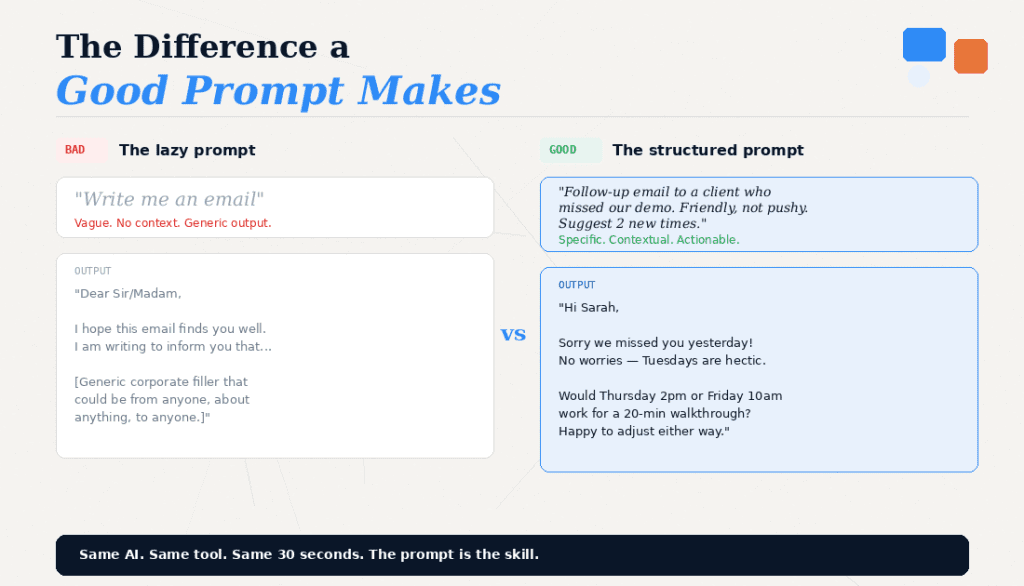
Notice the pattern? Essentially, you’re not just saying “write something.” You’re giving context, audience, tone, and format. That’s the difference between getting garbage back and getting something useful.
As a result, that brings us to the single most important insight in this entire post:
The prompt is the skill
However, this is the part most people miss.
Most importantly, AI is not a vending machine. You don’t put in a coin and get a Coke. It’s more like a very smart, very eager collaborator who just joined your team — but has zero context about your specific situation.
As a result, your job is to give it that context.
Same AI, same tool, same 30 seconds of your time. Wildly different results.
Therefore, the difference isn’t the model. It’s not the subscription tier. It’s the prompt.
I’ll be writing a lot more about prompting on The Prompt Mind blog (it’s kind of our thing). But here’s the starter framework you can use right now. For instance:
Role → Context → Task → Format
- Role: “You are a senior marketing strategist”
- Context: “I’m launching a B2B SaaS product for HR teams”
- Task: “Write a cold outreach email to HR directors”
- Format: “Keep it under 150 words. Include a subject line. End with a clear CTA.”
That’s it. Four pieces of information. Takes 30 seconds to write. Changes everything about the output you get.
The only 3 tools you need
When it comes to getting started with AI, you don’t need thousands of tools. You need three.
Additionally, I’ve tested most of the major ones. Here’s my honest breakdown:
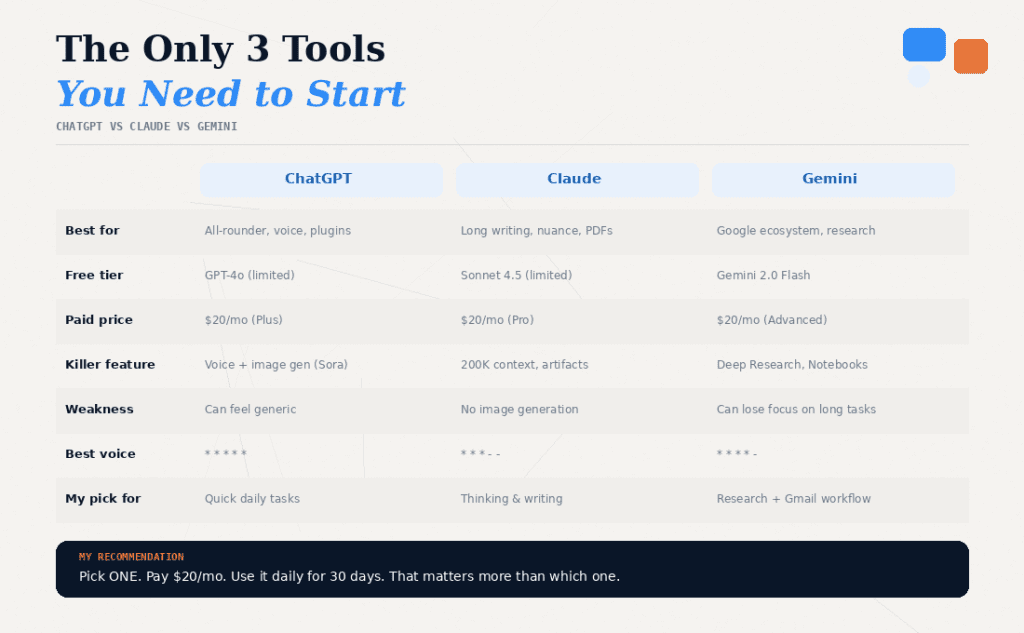
Here’s my actual recommendation: stop researching. Pick one. Pay for it. Use it every single day for 30 days.
So which one should you pick?
- ChatGPT if you want the jack-of-all-trades (and voice mode is incredible for brainstorming while walking)
- Claude if you do a lot of writing or need to upload long documents — it’s the best reader and thinker
- Gemini if you live in Google Workspace — it integrates with Gmail, Docs, and Drive in ways the others can’t
Consequently, the one you use daily beats the one you research weekly. Always.
After all, after 30 days, you’ll know whether the paid tier is worth it (it almost certainly is — $20/month is the best productivity investment you’ll make this year). And you’ll have enough experience to know what the tool can and can’t do for you specifically.
The mindset shift that matters more than tools
Here’s what I’ve noticed after helping dozens of professionals who are getting started with AI:
The people who get the most value don’t treat AI as a search engine. They don’t treat it as a magic button. They treat it as a thinking partner.
In other words, that means:
Iterate, don’t one-shot. Your first prompt won’t be perfect. Neither will AI’s first answer. That’s fine. Say “make it shorter,” “make it more casual,” “add a concrete example,” “try a completely different approach.” The conversation is the process.
Furthermore, start with what you already know. Don’t ask AI to do things you can’t evaluate. As a marketer, use it for marketing. As a manager, use it for communication. The magic happens when your expertise meets AI’s speed.
Above all, be specific, be honest, be demanding. If the output is mediocre, say so. Say “this is too generic” or “I need something more surprising.” AI responds to feedback. Give it.
What to ignore (for now)
Interestingly, this is almost more important than what to learn.
Ignore AI agents (for now). Yes, they’re coming. No, you don’t need them yet. Crawl, walk, run. You’re in the walk phase.
Similarly, skip fine-tuning and model comparisons. Unless you’re a developer, you don’t need to know the difference between GPT-4o and GPT-4 Turbo. Just use the default.
Don’t fall for the panic, either. “AI will replace all jobs” makes for great headlines and terrible advice. The reality is more nuanced and more interesting — and I’ll be writing about it a lot on this blog.
And definitely ignore anyone who says AI is “just a fad.” People said that about the internet in 1995. The same was said about smartphones in 2007. We know how that went.
Your homework for getting started with AI
I’m serious. Don’t bookmark this post and come back to it “when you have time.” Open a new tab. Go to chat.openai.com or claude.ai. Type in a real task from your day.
Then, see what happens.
The gap between “I should try AI” and actually getting started with AI is exactly one conversation.
So have that conversation today.
This is The Prompt Mind — a blog about thinking sharper in the AI era. New essays every Tuesday and Friday. If this helped you, subscribe below. If it helped you, it’ll help someone you know — share it.